
The GST invoice checklist I wish every freelancer used
A field-by-field checklist for Indian freelancers and small businesses: place of supply, invoice series, exports, e-invoicing, and the mistakes that cause rework.
Zynitex Engineering
Product & engineering notes
The short answer
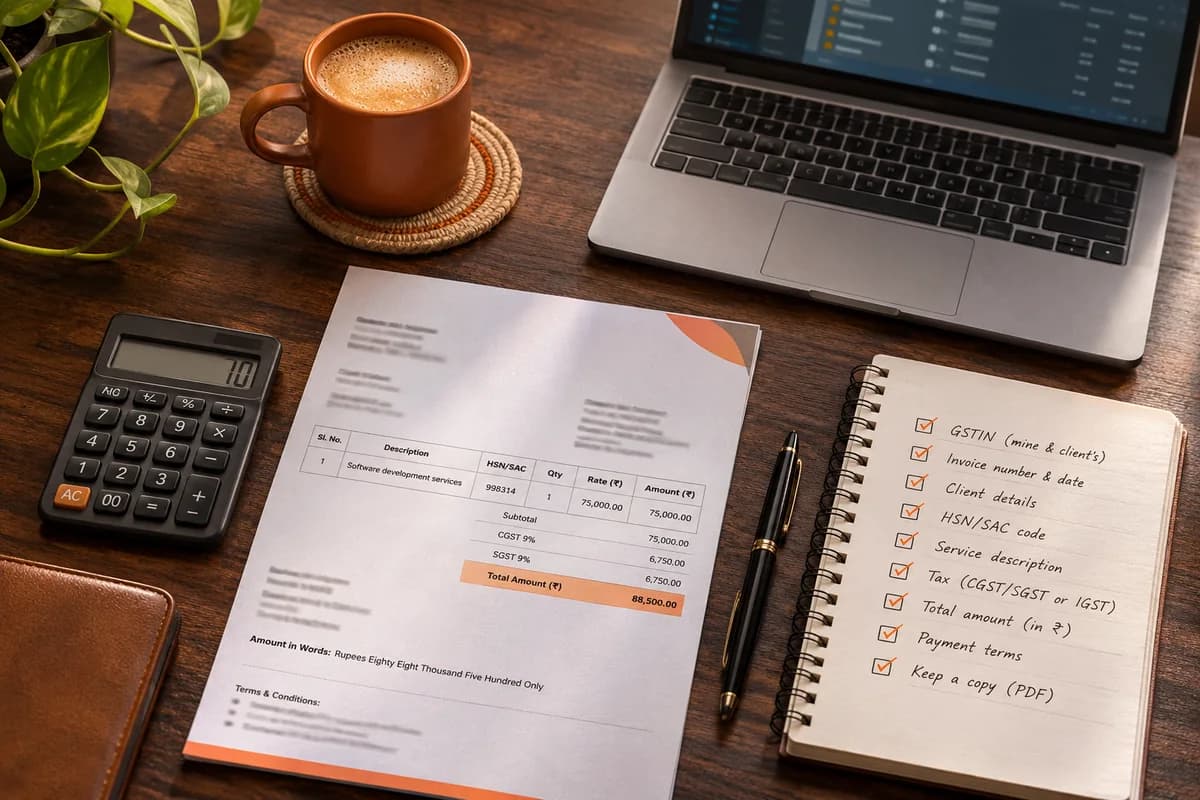
A valid Indian GST tax invoice needs your legal name, address, and GSTIN; a consecutive invoice number and date; the client’s details and GSTIN if registered; SAC or HSN, description, and taxable value; the correct CGST/SGST or IGST split with place of supply; and the tax amount. Get those right before worrying about the template.
What this note covers
- Name the document correctly: tax invoice, bill of supply, proforma, quotation, or credit note.
- Place of supply decides whether you charge CGST+SGST or IGST.
- Never charge GST without a registration; get the document type right first.
- Use one clean series per financial year and keep cancelled invoices in the record.
- Rates changed in 2025. Check the current notification instead of copying an old template.
On this page(12 sections)
- 01First, name the document correctly
- 02The fields that get checked
- 03Place of supply decides the tax split
- 04Invoice numbering that survives scrutiny
- 05GST rates changed. Your template probably didn’t.
- 06Exports and LUT
- 07E-invoicing: check whether it applies
- 08TDS, advances, and client portals
- 09A pre-send checklist
- 10Use a tool, then keep a copy
- 11The five-minute monthly habit
- 12Boring is the goal
A designer I know sent a beautiful invoice last month. The client’s accounts team sent it back the same day. Not because the design was bad, but because it called itself a “GST invoice” without a GSTIN, place of supply, or SAC. The work was fine. The paperwork wasn’t.
An invoice is a legal document with a design layer on top. Here’s the checklist I’d tape to a monitor.
First, name the document correctly
| Document | When to use it | What matters |
|---|---|---|
| Tax invoice | Registered supplier making a taxable supply | Charges GST and must contain the prescribed fields |
| Bill of supply | Registered supplier making an exempt or nil-rated supply | No GST charge; still a proper supply document |
| Proforma invoice | Before supply, for approval or an advance | Not a tax demand; don’t label it a tax invoice |
| Quotation | Before an agreement | Commercial document, not a tax invoice |
| Credit note | Reduction, return, or correction | References the original invoice and adjusts tax |
If you’re not registered under GST, don’t charge GST and don’t issue a tax invoice. You can issue a normal invoice or bill of supply depending on your situation. Get this wrong and you’re collecting a tax you can’t remit.
Watch out
Registration is not a branding decision
Charging GST without registration creates a liability and a reconciliation problem. If you’re unsure whether you need to register, ask a CA before you send the first invoice.
The fields that get checked
- Your legal name and registered address.
- Your GSTIN, displayed correctly.
- A consecutive invoice number and the invoice date.
- The client’s legal name and address; their GSTIN if they are registered.
- The place of supply, with the state code where your template supports it.
- The SAC for services or HSN for goods.
- A clear description of what was supplied.
- Quantity and unit — for many services, a quantity of 1 with a clear description is enough.
- Taxable value before tax, and any discount shown separately.
- The GST rate and amount, split into CGST and SGST or shown as IGST.
- A reverse-charge declaration where it applies.
- Your signature or digital signature, with designation where required.
| Field | Good example | Common mistake |
|---|---|---|
| Invoice number | INV-2026-27-0142 | Restarting at 001 and creating duplicates |
| Place of supply | Karnataka (29) | Omitting it, then splitting tax incorrectly |
| SAC | 998314 for IT design and development | Using a generic consulting code that doesn’t match the work |
| Tax split | CGST ₹900 + SGST ₹900 for an intra-state client | Charging IGST to a client in the same state |
| TDS | Invoice shows the full value; TDS is deducted at payment | Reducing the taxable value to “adjust” for TDS |
Place of supply decides the tax split
For most B2B services, the place of supply is the recipient’s location. If you’re in Karnataka and your client is in Maharashtra, that’s an inter-state supply and IGST applies. If both are in Karnataka, CGST and SGST apply. Get the state and GSTIN right before you choose the tax heads.
There are exceptions — immovable property, events, transport, and financial services, for example. If your work crosses those lines, ask a tax professional. A template won’t save you from a wrong place-of-supply rule.
Invoice numbering that survives scrutiny
- Use a distinct series per financial year or business vertical, and keep it consecutive.
- Don’t reuse a number after cancellation. Mark the invoice cancelled and retain it.
- If branches or terminals issue invoices, distinguish their series clearly.
- Retain records for the period required by GST law — commonly described as 72 months from the annual return due date. Confirm the current requirement for your business.
- Keep the PDF, the payment proof, and the ledger entry together.
Note
A cancelled invoice is still part of the series
Deleting a cancelled invoice from the file is not a numbering strategy. Keep the record and the reason.
GST rates changed. Your template probably didn’t.
The September 2025 rate rationalisation moved a lot of goods and services. Plenty of freelancers are still using a 2022 template with 12% and 28% options. Check the current notification for your service; don’t copy the rate from an old invoice.
Most B2B professional services sit at 18%, but “most” isn’t “all”. Restaurant services, construction, transport, and exports have their own rules. When in doubt, ask your CA and write the answer down for the next invoice.
Tax invoice
DraftBefore sending
Exports and LUT
If you export services, you generally don’t charge IGST. You may export under a letter of undertaking (LUT), or pay IGST and claim a refund. The invoice needs the export-specific details and should reference the LUT where applicable. Keep the payment evidence — FIRC, FIRA, or bank credit advice — with the invoice.
E-invoicing: check whether it applies
E-invoicing applies to registered businesses above the turnover threshold when supplying B2B. In 2026 the commonly cited threshold is ₹5 crore aggregate turnover, but thresholds move. Verify on the e-invoice portal before assuming you’re exempt. If you are covered, the IRP-generated invoice and QR become part of the document.
Note
Thresholds age quickly
Treat any threshold in a blog post as a prompt to check the source, not a substitute for it.
TDS, advances, and client portals
- TDS is deducted by the client at payment. Don’t reduce the invoice value to “account for” it.
- Advances for services may need a receipt voucher and a later adjustment. Ask your CA how to handle them.
- Purchase orders often demand a vendor code, cost centre, and PO number. Add those fields to your template from day one.
- If you invoice in a foreign currency, show the currency, the exchange rate used, and the INR equivalent where your records need it.
A pre-send checklist
- The document type matches the supply and your registration.
- Your GSTIN is active and correctly formatted.
- The invoice number is unique and in sequence.
- The invoice date and place of supply are correct.
- The client’s legal name and GSTIN match their records.
- The SAC or HSN matches the work.
- The description is specific enough to defend.
- The taxable value and discount are clear.
- CGST/SGST or IGST is correct, and the totals add up.
- Reverse charge is declared where applicable.
- The signature, bank details, and UPI link are present.
- The PDF filename is professional and searchable.
Use a tool, then keep a copy
Invoice Studio calculates CGST, SGST, and IGST, supports tax invoices, quotations, and export invoices, and exports a PDF without a login. Your data stays in the browser, which is good for privacy and bad for accidental device loss. Download the PDF, save it to your books, and back up the source file.
A tool removes arithmetic mistakes. It doesn’t remove the need to understand the fields. The best invoice software in the world can’t fix a wrong place of supply.
The five-minute monthly habit
Once a month, open your invoice folder and check four things: sequence gaps, unpaid invoices, GST totals against your GSTR-1, and client GSTINs that changed. Five minutes beats a panicked email in March.
Boring is the goal
A good invoice is boring in the right way. The client’s accounts team can match it, your CA can reconcile it, and you can explain every field without opening a browser tab. Design the template once, check the current rules, and then spend your energy on the work.
Direct answers
Questions people actually ask
Short, checkable answers. Every entry here is also published as structured FAQ data for search and answer engines.
Can I issue a GST invoice without registering for GST?
No. Only a registered person can issue a tax invoice and charge GST. If you’re unregistered, issue a normal invoice or bill of supply as appropriate, and don’t collect GST. Check whether your turnover or type of supply makes registration mandatory.
Is a signature mandatory on a GST invoice?
Tax invoice rules generally require the supplier’s signature or digital signature, with designation where applicable. Electronic signatures and e-invoice QR requirements have their own rules. Check the current requirement for your document type.
Can I create GST invoices in Excel or Word?
Yes, if the document contains the required fields and you keep proper records. The tool doesn’t make an invoice valid; the contents and your registration do. A dedicated tool mainly reduces arithmetic and formatting mistakes.
Do I need an HSN or SAC code on every invoice?
Tax invoice rules require an HSN or SAC. For services, use the SAC that matches the service. The number of digits required can depend on turnover and the type of supply, so verify the current rule.
Do I charge GST on exports?
Generally no, when you export under an LUT; otherwise you may pay IGST and claim a refund. The invoice must include export details and you should keep payment evidence. Confirm the treatment with your CA.
References
Sources and further reading
- CBIC — GST portal and rules
Primary source for invoice contents and current notifications.
- GST Council
Rate decisions and council updates.
- Invoice Studio — free GST invoice generator
The tool referenced in this article.
- Income Tax Department — Section 43B(h) context
Relevant if you are an MSME supplier.
Compliance notes are operational guidance, not legal or tax advice. Rules and thresholds change — confirm your position with a qualified professional.
Written by
Zynitex Engineering
We design and build the systems behind Zynibill, Invoice Studio, and client platforms like Regalia, Kristive, and ElyteSpark. These notes are the things we wish we had read before shipping them.
More about ZynitexKeep reading
Related notes
Offline-first billing: what actually breaks when the internet dies
A dead router shouldn't stop a restaurant from taking orders or printing bills. The architecture, GST numbering trap, and sync design behind offline billing.
6 October 2026·9 minBusinessThe small-business software stack for India in 2026
Four jobs, not nineteen subscriptions. A practical stack for freelancers, restaurants, D2C brands, and services firms — with budgets and a 30-day rollout.
16 October 2026·11 minBusinessWhen custom software is worth it (and when it’s an expensive hobby)
A decision framework with real economics: status-quo cost, three-year ownership, the 80% rule, hybrids, and the questions to ask before you sign.
15 September 2026·9 min